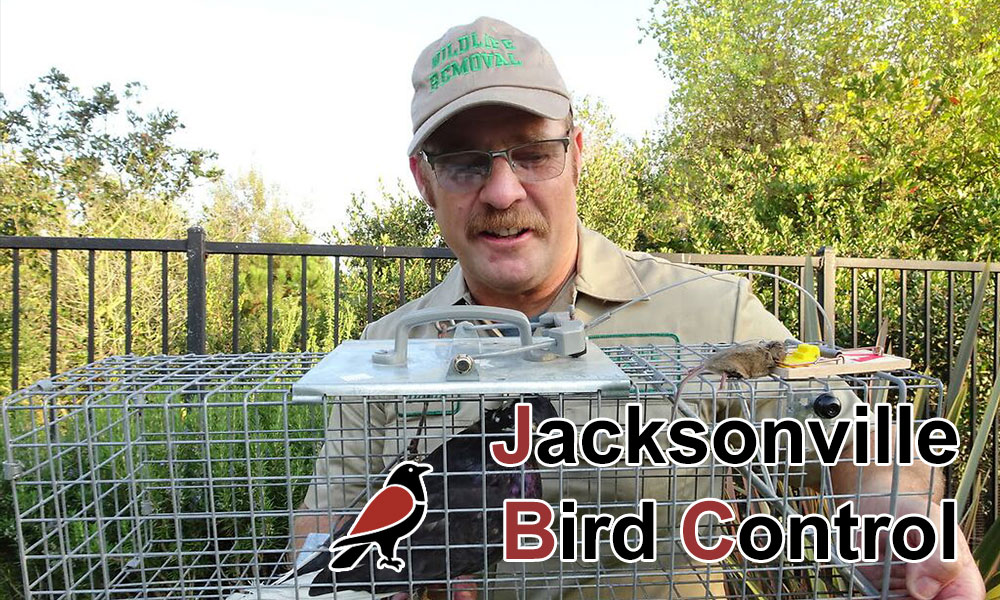
Welcome to Jacksonville Bird Control: Prevention and Removal of Unwanted Birds
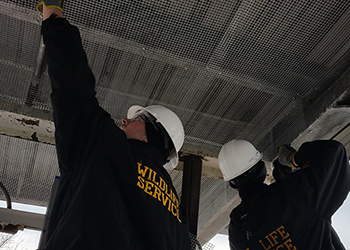
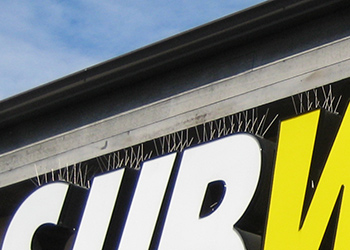
Our company specializes in resolving problems caused by birds in Jacksonville, Florida, both residential and commerical. We handle bird species such as pigeons, starlings, grackles, sparros, and even Canada Geese and woodpeckers. We generally don't kill birds - we prevent them from causing problems. Most commonly, this means that we install barriers that prevent them access to your building or property, or anti-roosting devices that prevent them from landing, nesting, or roosting on your home, store, building, or anywhere. We use netting, needle strips, shock track, and more. We do offer trapping in some cases, and removal of birds from warehouses, grocery stores, or other commerical or industrial buildings by netting or sometimes pellet shooting. We have a wide variety of tools and methods for solving every manner of bird problem. Call us at 904-300-0640 to discuss your bird problem today.Our Work
Full Range of Bird Control Services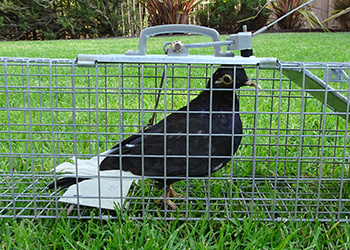
More About Us Jacksonville Bird Control:
Whether you are a home or business owner here, the last thing you want to know is that birds are infesting your house. This is where our company can help you; we will focus on giving you a lasting result. We will directly attack the source of your problem. We believe in providing the highest level of satisfaction. Regardless if you require a one-time service or a periodic inspection of your house, we can give it all to you. We are the only bird control company in the area that can provide you with emergency service. We can help you with your concern during off-business hours and even during weekends or holidays. We will be there for you 24/7 at no additional cost. We are committed to providing transparent and honest service. When you ask for a free quote from us, we will provide you with a comprehensive breakdown of the cost. There will be no mystery charges. If there are no changes to the services we will deliver, our binding quote will be the exact amount of money you need to settle. We are armed with liability insurance to prevent any unforeseen expenses, and we are licensed and certified by the state, which will keep you away from any legal repercussions.What to Do With a Pigeon That Can't Fly
It is not uncommon to find wild animals that are sick or injured to a point where they can no longer take care of themselves, and when you have birds like pigeons getting into residential areas (where they commonly live), it'll only be a matter of time before conflict arises, the birds coming out of the situation the worse-off.
Domesticated pets love to chase pigeons in the backyard. Both cats and dogs will go into a frenzy when they see them hanging out in the backyard, and out of both natural, territorial aggression, and playfulness, the conflict can result in the pigeon becoming injured.
Pets aren't the only problem as far as maimed pigeons are concerned; humans are just as bad. We may not physically attack these birds with teeth and claws, but we do attack them in other ways. Some homeowners will use poison to try and get rid of them. There isn't a registered or lawfully permitted poison that is safe to use for birds, so that action will leave you open to potential prosecution if you are caught in the act. In most cases, the pigeons do not die. This could be because not enough poison has been used, or the poison concoction isn't powerful enough to actually kill the animal. What it does mean, though, is that dying pigeons will be left vulnerable, slow, and unable to protect themselves against predatory attacks. Those predatory attacks could come from your pet.
If your pet has brought you a pigeon that can't fly, or you find one in your backyard, we do not recommend that you get too close. There is a chance that it could have been poisoned by human hands, at which point, you certainly wouldn't want your pets to eat it. If they were to ingest the poisoned meat, they too could suffer the effects of that poisoning, albeit on a less intense level.
Even if the pigeon weren't poisoned, there could be other problems keeping it from flying away. Mites and other parasites are rife in these pest populations, and that's before you look into the world of bacteria and viruses, such as E.coli and salmonella.
The kindest and most humane way for you to deal with this situation is to kill the animal as soon as possible, and as quickly as possible. This is best performed by a wildlife removal specialist, who can then check the surrounding area to make sure no other pigeons are going to pose a problem, and also to check that your property is actually pigeon-proof. At the same time, he or she may remove and clean up any pigeon droppings and, in turn, the disease threats found within it.
Pigeons can be rehabilitated with care, but not by someone who isn't experienced. If the bird has been injured, however, the chances of it surviving are slim. Rehabilitators for pigeons and other disease-ridden pest species can be very hard to come by.
Also read our other bird tip: What property modifications will keep down pigeon populations?
We have the most experience in Jacksonville at understanding the nuisance birds of Florida. Our 7 years of experience in the field ensures excellent results.
We pride ourselves on the quality of our bird control work. Our work is professional grade and long lasting, usually for the life of the building.
We are fully Florida licensed. We carry the correct safety equipment, and operate in a safe and professional manner to keep your building and people safe.
Call us at 904-300-0640 to discuss your bird problem and our process. We are always responsive by phone. We can usually schedule next-day appointments, and provide written estimates for all our bird work.
Thank you Jacksonville Bird Control for keeping the pigeons off of my storefront. My sidewalks are clean now!
These guys were the only ones who could get a sparrow out of my clothing store. Thank you!
Your goose abatement program has kept my golf course dropping-free. I recommend Jacksonville Bird Control.